

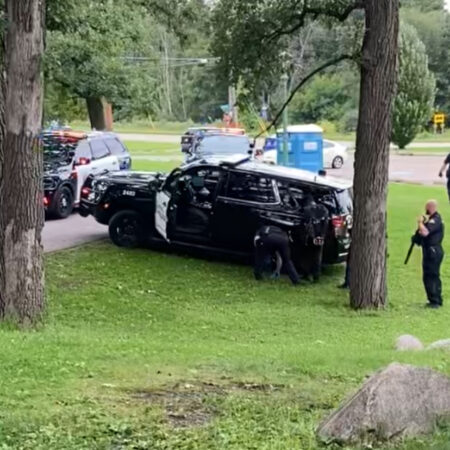
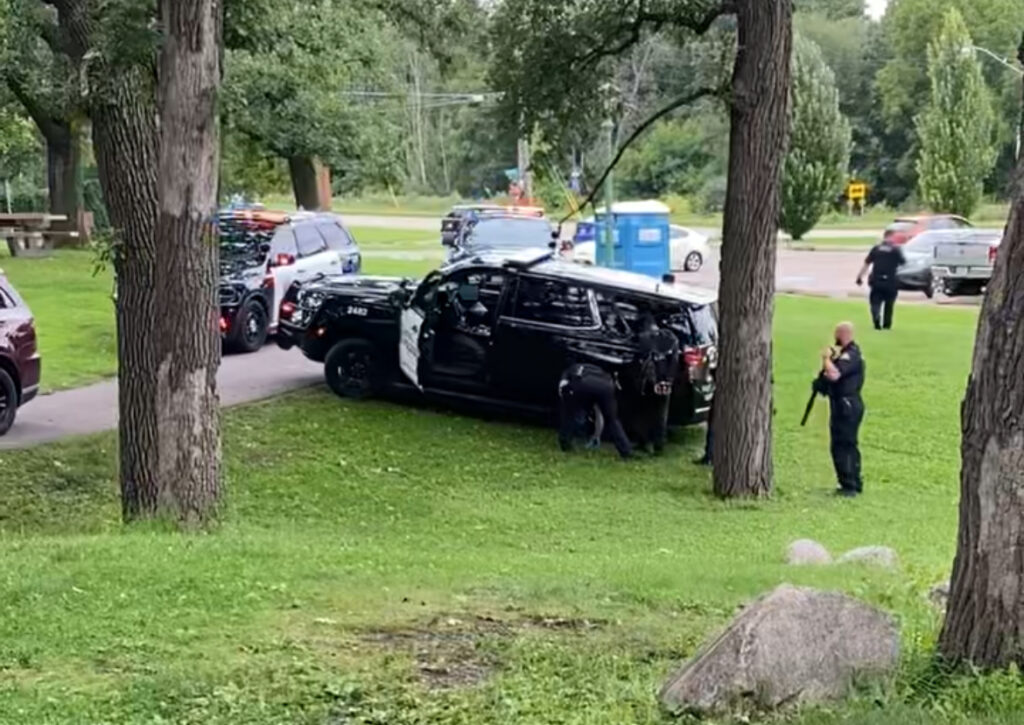
The irony was not lost on us as our voices lifted the final notes of “May the love of God send you out” into the morning air. Within moments, that love would be tested not in the abstract realm of Sunday sentiment, but in the concrete reality of flashing lights, drawn weapons, and a human being face-down on the grass mere yards from our makeshift sanctuary.
What happened next was not planned. There was no committee meeting, no strategic discussion, no careful weighing of options. Instead, there was something far more profound: the instinctive response of a people shaped by centuries of Moravian witness, a community whose DNA carries the memory of persecution and the conviction that faith must be lived in the world, not sheltered from it.
As five, six, seven police cars descended upon our park worship space like a scene from a crime drama, transforming our peaceful morning into something that felt surreal and urgent, my congregation did not scatter. They did not retreat into the safety of prayer alone, though prayer would come. Instead, they became what Moravians have always been called to be: faithful witnesses in the intersection of heaven and earth.
The phones came out—not for social media performance, but for accountability. In an age where truth can be contested and stories rewritten, my parishioners understood instinctively that bearing witness means creating a record. They filmed because they know that cameras can be instruments of justice, that documentation can protect both the vulnerable and the truth itself. This was not voyeurism; this was stewardship of the moment.
But the filming was only the beginning. As officers approached the suspect with weapons drawn, including assault rifles that seemed grotesquely disproportionate to the situation unfolding before us, voices from our congregation began to call out observations. “He’s complying.” “He’s not resisting.” “There’s no need for that level of force.” These were not the shouts of agitators or troublemakers, but the steady, clear voices of people who understand that silence in the face of potential injustice is complicity.
The search dog’s aggressive barking, encouraged by its handler, created an atmosphere of violence that seemed to feed on itself. In that moment, my congregation became a different kind of chorus—not singing hymns, but speaking truth to power with the same conviction that had lifted their voices in worship moments before. They reminded the officers, in real time, that the person before them was human, was compliant, was deserving of dignity even in arrest.
Even when one officer told a teenager in our church to “get the F* out of here,” we continued to bear witness and be a presence of love. We didn’t respond with anger or aggression, though the officer’s words stung. Instead, we held our ground with quiet determination, understanding that our calling was not to escalate conflict but to maintain space for dignity and accountability. The teenager, showing remarkable maturity, stepped back but didn’t leave entirely—continuing to witness from a respectful distance. In that moment, our young person embodied the kind of courage and restraint that reflects the best of our faith tradition.
Our response emerged from a deep conviction that runs through everything we do as a community: we honor the humanity of all people. This wasn’t theoretical theology in action—it was lived experience informing faithful witness. We are a small congregation worshiping outdoors this summer to save money, though we usually gather in a community space dedicated to telling the stories of peoples on the margins. Even in the park, we carried that commitment with us.
Perhaps most significantly, we are a community of people who know trauma intimately. Church trauma that left spiritual wounds from institutions that weaponized faith. Physical trauma that marked bodies and memories. Relational trauma that broke trust and shattered assumptions about safety. Historical trauma inherited from generations of harm and oppression. We could have been crushed by these experiences, could have retreated into cynicism or self-protection.
Instead, we made a different choice. We centered our mental health and the best parts of our spirituality, refusing to let trauma have the final word about who we would become. Through therapy, honest conversation, and theological wrestling, we developed what I can only describe as an emotionally intelligent, theologically sound approach to our spiritual journeys. We learned to hold complexity, to extend grace while maintaining boundaries, to seek healing while refusing to minimize harm.
This foundation—this hard-won wisdom about trauma and recovery—shaped everything about how we responded that morning. When we saw the suspect on the ground, we didn’t see a faceless criminal. We saw someone’s child, someone who might be carrying their own trauma, someone made in the image of God even in their worst moment. When we watched the officers with their weapons drawn, we didn’t see enemies or oppressors. We saw human beings doing difficult work in a system that often fails them, people who carry their own burdens and fears, people also made in the divine image.
And when we prayed for the victims of the car robbery, we prayed from our own deep understanding of what it means to have your sense of safety shattered, to experience violation, to need restoration not just from physical harm but from the spiritual wound that trauma creates. We know that healing from trauma is not just about moving past what happened—it’s about finding wholeness that acknowledges the harm while refusing to be defined by it.
This response flows directly from our Moravian heritage, though it might surprise those unfamiliar with our tradition. We are heirs to the Unitas Fratrum, the Unity of Brethren, a movement born in the crucible of 15th-century religious persecution. Our ancestors knew what it meant to be marginalized, to be hunted, to be at the mercy of those with power. Count Zinzendorf’s radical vision of Christian community was not built on comfortable piety but on the revolutionary idea that faith must engage the world’s brokenness with both courage and love.
The Moravian commitment to social justice isn’t an addendum to our faith—it’s woven into our theological DNA. Our early communities were integrated when such integration was scandalous. Our missionaries didn’t just preach; they challenged systems of oppression. Our understanding of Jesus is not of a gentle shepherd removed from conflict, but of one who consistently stood with the marginalized against the powerful, who overturned tables when justice demanded it.
Yet we must acknowledge that our denomination hasn’t always been perfect in this regard. Like many faith communities, we have been complicit in systems of harm, silent when we should have spoken, absent when faithful witness was most needed. We have failed to live up to our own calling, sometimes choosing comfort over courage, reputation over righteousness. These failures are not abstract historical footnotes—they have caused real harm to real people.
But rather than retreat into defensiveness or despair, we have tried to listen, to learn, and to make repair where possible. We have engaged in difficult conversations about our complicity, acknowledged where we have fallen short, and committed ourselves to doing better. We do this not because it’s comfortable or easy, but because we care deeply about the integrity of our witness. We want to be a wide, hopeful tent where all spiritual refugees—those wounded by church, by society, by life itself—can find a home. This work of repair and renewal isn’t separate from our faith; it is our faith in action.
So when my congregation circled up to pray after the arrest, they weren’t retreating from engagement into spirituality. They were deepening it. The prayer for the victims of the car robbery acknowledged real harm and real trauma. The prayer for the police recognized their humanity while not excusing potential abuse of power. The prayer for the suspects—including the one who had just been taken away in handcuffs—embodied the radical Christian conviction that no one is beyond the reach of God’s love, that even those who harm others carry the divine image.
This is what progressive Christianity looks like when it moves beyond comfortable platitudes. It’s not about having the right political opinions or displaying the correct social media posts. It’s about allowing the gospel to form us into people who cannot remain passive when witnessing potential injustice, who cannot separate worship from witness, who understand that following Jesus means standing where he stood—with the vulnerable, the marginalized, the silenced.
The morning’s events crystallized something essential about Moravian spirituality: we are called to be present in the tensions of the world, not absent from them. Our worship doesn’t lift us out of the messiness of human existence; it prepares us to enter it more fully. The benediction that sent us out was not metaphorical—it was preparation for exactly the kind of moment we encountered.
In a time when Christianity is often associated with political power, cultural dominance, and the protection of privilege, what happened in that park represents a different way. It shows faith communities serving as moral witnesses, creating spaces of accountability, and extending the circle of prayer to include all who are caught in cycles of harm and violence.
The love of God that our benediction song proclaimed didn’t end with the song. It walked with us toward the flashing lights, spoke through our voices calling for restraint, guided our hands holding cameras, and gathered us into a circle of prayer that embraced victims, officers, and suspects alike. This is what it means to be Moravian: to believe that God’s love is not a Sunday sentiment but a Monday-through-Saturday calling to bear witness, seek justice, and extend grace even—especially—in moments when the world seems to demand we choose sides rather than choose love.
In the end, we did what Moravians have always done: we showed up, we paid attention, we spoke truth, and we prayed. Not because it was comfortable, but because it was faithful. Not because it was safe, but because it was right. And in doing so, we discovered once again that the love of God doesn’t just send us out—it sends us exactly where we need to be.